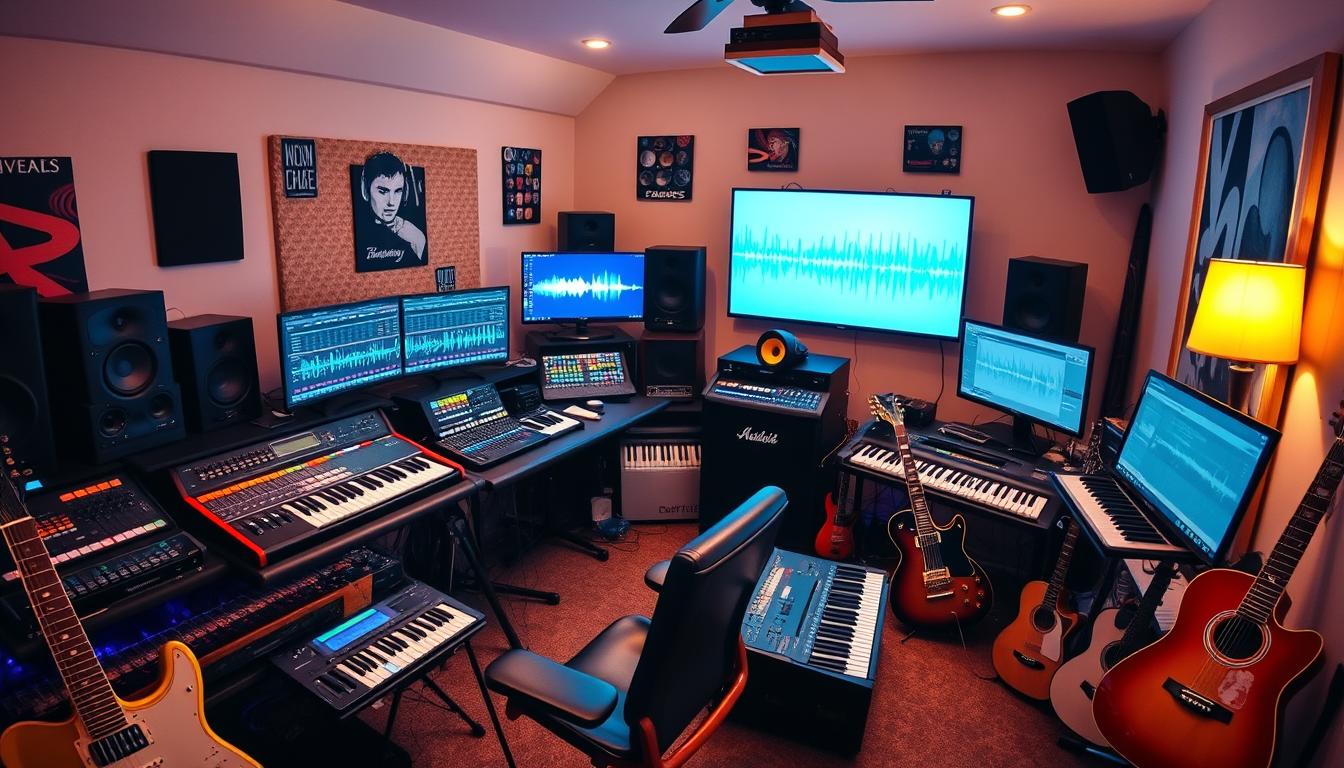
Unlock the power of music production and start creating your own masterpieces. This guide is for anyone who loves music, whether you’re a musician, audio engineer, or just a music enthusiast. You’ll learn the basics and get the tools to start making your own music.
We’ll cover the basics of music production and audio engineering. You’ll learn how to make professional-quality tracks. We’ll talk about setting up your home studio and more, to help you begin your musical journey.
Music production opens up a world of possibilities. Get ready for a journey filled with creativity and joy. Let’s start and see how far you can go with your music!
Understanding Music Production Basics
Exploring Audio Engineering, Music Technology, and Sound Design is thrilling for those who love music. It’s all about grasping the basics of music production.
Signal flow is key – it’s how audio signals move from start to finish. Knowing this helps make your music sound polished. Also, learning about audio formats like WAV, AIFF, and MP3 is crucial. It ensures your music works on various platforms.
But it’s not just about tech. The roles of producers, engineers, and artists are vital too. Producers guide the creative path, engineers handle the sound, and artists bring their vision to life. Knowing how these roles work together helps you work better with others.
Lastly, learning about sound design opens up endless creative options. Understanding waveforms, synthesis, and sound processing lets you create unique sounds. This boosts your Music Technology skills.
“The true beauty of music is that it connects people. It carries a message, and we, the musicians, are the messengers.”
By learning these basics, you’ll unlock the power of Audio Engineering. You’ll be ready to bring your music dreams to life.
Essential Equipment for Music Production
Starting as a music producer means having the right tools. From computers to microphones, the right gear is key. It helps bring your music ideas to life. Let’s look at the main things you need for a home Audio Engineering studio.
A good computer is the base of any music production setup. It should run smoothly, with enough power and storage. This is important for using digital audio workstations (DAWs) and sound processing software.

An audio interface connects your instruments and microphones to your computer. It ensures your audio is top-notch. Choose one that fits your needs, with the right number of inputs and outputs.
You’ll also need a quality microphone. For different sounds, you might need various mics. Look for brands known for their clear sound and reliability.
Don’t forget headphones and studio monitors. Headphones help you check your recordings closely. Studio monitors give you a true sound for mixing and tweaking.
“The right equipment can make all the difference in the world when it comes to Music Recording and Music Technology. Invest in quality gear and you’ll be well on your way to creating professional-sounding tracks.”
Choosing the right equipment is crucial for music production. It lets you work on your music with precision. Keep adding to your tools as you grow and learn more.
Choosing the Right Digital Audio Workstation (DAW)
Starting your music production journey? Picking the right Digital Audio Workstation (DAW) is key. DAWs are the heart of making music today. They let you create, record, edit, and mix your songs. With so many options, from Ableton Live and Logic Pro to FL Studio, choosing can be tough.
Understanding each DAW’s unique features is crucial. *Ableton Live* is great for live performances and its session view. *Logic Pro* excels in traditional recording and mixing, with lots of tools and an easy interface. *FL Studio* is loved for its pattern-based music making, attracting artists from hip-hop to EDM.
“The right DAW is the one that enables you to express your musical vision with the least amount of friction.”
Choosing a DAW depends on your personal taste, production style, and needed features. By looking into each *Music Software*, you can find the best fit for your *Music Technology* workflow and dreams.
Setting Up Your Home Studio
Starting a music recording, audio engineering, or sound design project begins with a well-set home studio. It’s key to focus on room acoustics, soundproofing, and where to place your gear.
First, check how your recording space sounds. Use soft items like curtains and carpets to control echo. Move your audio engineering equipment around to cut down on bad reflections and resonance.

Soundproofing is also vital for a home music recording studio. Insulate walls, ceilings, and doors to stop sound from getting out. Use acoustic panels or foam to soak up sound waves and reduce noise.
With a well-thought-out home sound design studio, you’re on the path to great audio. The trick is to keep trying, listen closely, and tweak until it sounds just right.
Music Composition Techniques
Making your own music is thrilling. Learning the basics of music composition, sound design, and music technology is key. It unlocks your creative potential.
Writing melodies is a big part of music composition. Creating a melody that touches your audience is an art. Try out different notes, rhythms, and shapes to find your sound. Chord progressions are also vital. They give your music its harmony. Play with chord voicings and progressions to add feeling to your songs.
“Music is a moral law. It gives soul to the universe, wings to the mind, flight to the imagination, and charm and gaiety to life and to everything.” – Plato
Arranging your music is another important skill. It involves choosing instruments, setting dynamics, and controlling the pace. Learning from various genres helps you craft music that grabs your listeners’ attention.
The path of music composition is full of discovery and creativity. By using all the techniques and tools available, you can create music that’s truly yours. Let your imagination run wild and start a musical journey that will amaze and uplift.
Recording Your Music
Making great music is more than just creativity. It also needs a deep understanding of music recording and audio engineering. As you start making music, learning these skills is key to bringing your ideas to life.
The art of using microphones is central to recording. It’s about capturing the right sound of guitars, singers, or electronic beats. The right microphone and how you place it can greatly improve your music production.
“The microphone is the first and most important step in the recording chain. Get that right, and the rest will follow.”
Learning about gain staging is also crucial. It’s about balancing the levels of different sounds. This helps avoid distortion and keeps the sound clear and full.
With attention to detail and a solid grasp of audio, you’re on your way to making top-notch recordings. These recordings will be the base of your musical creations. By mastering music recording and audio engineering, you’ll enhance your music production skills. Your recordings will then truly engage your listeners.
Mixing Fundamentals
Starting as a music producer means learning audio mixing basics. Mixing blends different parts of your song into one cohesive sound. It involves equalizing sounds, adding reverb, and panning to make your music sound professional.
Equalizing (EQ) is key in mixing. It lets you adjust sound frequencies to make each part of your song stand out. Good EQ balances your mix, making it sound clear and complete.
“Mixing is like painting a picture – you have to know when to stop.”
Compression is another vital technique. It evens out loud and soft parts, making your sound more consistent. Try different compression levels to find the right feel for your song.
Panning and reverb also play big roles. Panning spreads sounds across the stereo field, adding depth. Reverb adds space and ambiance, tying your song together.
Mixing is an art that takes time and effort. Keep trying, listen closely, and follow your gut. With hard work and a good ear, you’ll improve your music production skills.
Mastering Your Tracks
Music production doesn’t stop after mixing. The last step, audio mastering, is key to making your music sound great everywhere. It fine-tunes the sound, balance, and dynamics of your music. This gets it ready for listeners and distribution.
Mastering your music production needs a careful touch. It requires knowing music technology and audio engineering well. Mastering engineers tweak the sound, making your tracks sound their best.
“Mastering is the final step in the audio production process, where a skilled engineer takes your mixed tracks and makes them sound as good as possible for commercial release.”
Mastering is essential for music release on any platform. Working with a skilled engineer or using top-notch software can make your music stand out. This way, your music will grab listeners and leave a memorable mark.

Incorporating Music Theory
As a music producer, knowing music theory basics can boost your Music Composition, Music Production, and Sound Design skills. Learning about scales, harmony, and rhythm opens up new ways to make music more complex and interesting.
Scales are key to melodies and harmonies. Knowing major, minor, and modal scales helps you make better chord progressions and melodies. Learning about different scales and their feelings can spark new ideas for your music.
Harmony is about intervals, chords, and progressions. It lets you create deeper and more engaging harmonies. Understanding consonance, dissonance, and chord structure can make your music more emotional and impactful.
“Music theory is the language of music, and the more fluent you become in that language, the more expressive and nuanced your musical compositions will be.”
Rhythm is also vital. Studying time signatures, rhythmic patterns, and syncopation can make your rhythms more complex and engaging. Trying out different rhythmic techniques can add excitement and interest to your Music Production and Sound Design.
Adding music theory to your work might seem hard at first. But the benefits are huge. Knowing music’s underlying rules can open up new creative paths for your Music Composition and help you reach your full potential as a producer.
Collaborating with Other Musicians
Collaboration is key in music production and music recording. Working with other talented musicians opens up new creative doors. It helps you reach new levels in music technology. You can team up with vocalists, instrumentalists, or other producers.
Collaboration lets you tap into different skills and views. Each musician brings their own experiences and ideas. This can lead to new sounds and fresh ways to create music.
“Collaboration is the essence of creativity. When you bring together diverse talents and perspectives, magic happens.”
Collaboration also helps solve creative blocks and makes recording smoother. By sharing tasks, you work more efficiently. This is great when you’re working from home or have little studio time.
Whether you’re experienced or just starting, collaboration can boost your skills. So, don’t hesitate to connect with other artists. Together, you can create amazing music.

Promoting Your Music
In today’s music world, getting your music out there is crucial. You can use social media and music streaming sites to reach more people. These strategies help you connect with fans and grow your fan base.
Sites like Instagram, Twitter, and Facebook are great for musicians. They let you share your Music Production and talk to fans. Posting regularly and engaging with your followers builds a strong online presence.
“The key to success on social media is to be authentic, consistent, and provide value to your audience.”
Music streaming services like Spotify, Apple Music, and SoundCloud are also key. They help you share your Digital Audio Workstations (DAWs) with more people. This way, you can find new fans and grow your audience.
Working with other artists and industry folks is also important. Going to music events, meeting other artists, and doing Music Production collaborations can help. It expands your reach and brings in new fans.
Promoting your music online is a continuous effort. It needs creativity, regular updates, and a real connection with your audience. By using social media, streaming sites, and networking, you can share your Music Technology with the world.
Resources for Continued Learning
Music production is always changing, and it’s key to keep up with new trends and tech. Luckily, there are many online resources to help you grow in Music Production, Audio Engineering, and Music Technology.
Check out the huge selection of online courses on Udemy, Coursera, and Skillshare. These sites have classes for all levels, from beginners to experts. You can learn about software tools or music theory, and find a course that matches your goals.
YouTube also has many tutorial channels with free, top-notch content. You can find everything from DAW tutorials to mixing and mastering tips. Plus, joining online communities lets you connect with others, share ideas, and learn from their experiences.