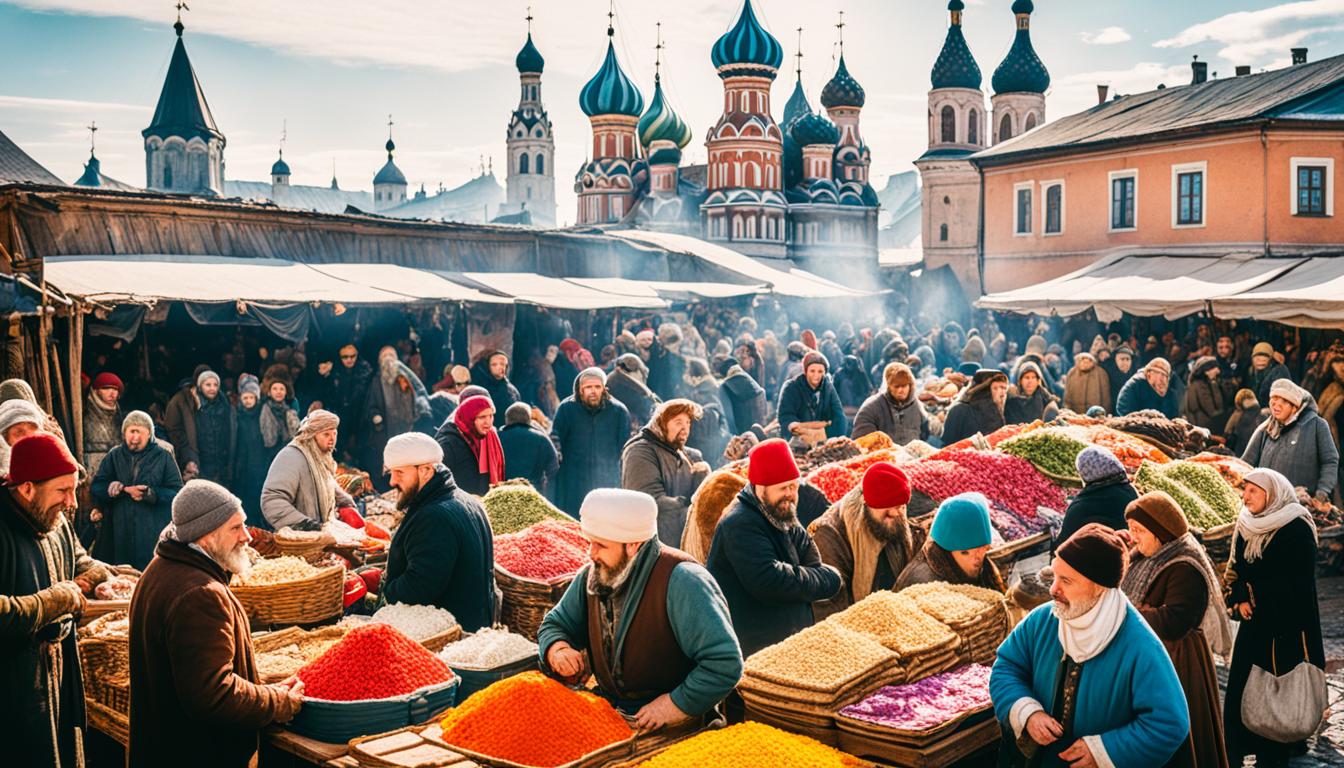
Russia’s history and culture have always caught the world’s eye. From ancient times to now, the Russian people have created a rich heritage. This article will take you deep into Russian culture, showing you the country’s past and lasting customs.
Across Russia’s vast lands, we’ll find its diversity. From the Ural Mountains to the Black Sea, the country has always drawn explorers. Let’s explore the unique places and cultures that make Russia special.
Russia’s history goes way back to the beginning of civilization. We’ll look at the early civilizations that helped create the Rus’ and the Kievan Rus’. Then, we’ll see how the Mongol invasion, the Tatar Yoke, and Orthodox Christianity shaped Russia.
The Vast and Diverse Russian Landscape
Russia stretches across 11 time zones, showing off a wide range of climates and ecosystems. From the icy tundra in the north to the vast grasslands in the center, its landscape is truly vast and complex. This country is a mix of different climates and natural areas.
Exploring the Diverse Regions and Cultures
When you explore Russia, you find many unique cultures and traditions. The rugged mountains of Siberia are home to communities closely tied to nature. In European Russia, the hills and forests support old settlements and lively cities.
Natural Wonders: From Tundra to Steppes
Russia is full of stunning natural sights. The tundra’s beauty, the Ural Mountains’ grandeur, and the endless steppes all leave you in awe. These landscapes show the beauty of nature in a way you won’t find anywhere else.
Ancient Roots: The Early Civilizations
Before the Rus’ and the Muscovite Tsardom became known, Russia had a rich history of ancient cultures. The Scythians, Sarmatians, and Huns were key to this heritage.
The Scythians were nomads famous for their horse skills and beautiful metalwork. They lived in the Eurasian Steppe from the 8th century BCE to the 4th century CE. Their tombs and gold artifacts show us their culture.
After the Scythians, the Sarmatians came to power. They were a group of Iranian-speaking nomads who ruled the Pontic-Caspian Steppe from the 5th century BCE to the 4th century CE. They were known for their strong military and beautiful art, like jewelry and metalwork.
In the 4th century CE, the Huns arrived, changing history. They met with the Scythians and Sarmatians, leading to new politics and culture. This set the stage for what was to come in the region.
The Rise of the Rus’ and Kievan Rus’
The Rus’ people, a mix of Scandinavian traders and warriors, built a strong civilization in the 9th century. This civilization, based in Kiev, became a major force in Eastern Europe. It shaped the region’s politics and culture for many years.
The Adoption of Russian Orthodox Christianity
In 988 AD, Prince Vladimir of the Kievan Rus’ made a big decision. He converted the Rus’ people to Russian Orthodox Christianity. This move changed Russian history forever.
It made the Kievan Rus’ a key player in regional politics. It also shaped the cultural and religious identity of the Rus’ people. They kept the Orthodox faith even after the Kievan Rus’ declined.
Choosing Russian Orthodox Christianity was a big step for the Kievan Rus’. It linked them to the Byzantine world. This faith brought new beliefs, practices, and a rich tradition in art and architecture. This tradition would shape Russian aesthetics for centuries.

The Kievan Rus’ and the Rus’ people had a lasting impact on Eastern Europe. Their choice to adopt Russian Orthodox Christianity was crucial. It shaped the cultural and religious identity of the Rus’ people for many generations.
The Mongol Invasion and the Tatar Yoke
In the 13th century, a major event changed Russian history forever – the Mongol invasion of Russia. This invasion, led by the powerful Mongol Empire, started a period of Mongol rule known as the Tatar Yoke. The Mongols left a lasting impact on Russian culture, affecting politics, society, and language.
The Mongol invasion of Russia started in the 1230s. Led by Genghis Khan, the Mongols moved across the Russian plains, breaking the Kievan Rus’ principalities. This led to the rule of the Mongol Golden Horde over Russian lands for centuries.
The Tatar Yoke had big effects on the Russian people. The Mongols took tribute and reduced local freedom. This period helped the Grand Duchy of Moscow grow strong, setting the stage for the Russian Empire.
Despite the challenges, the Tatar Yoke changed Russian culture for the better. The Mongols brought new tech, architecture, and food traditions that became part of Russian life. The Russian language also gained Mongol words, showing the deep cultural exchange during this time.
The Emergence of the Muscovite Tsardom
After the Mongols left, the Muscovite Tsardom grew strong. It expanded and brought Russian lands together. This was a key moment in the region’s history. Moscow became the heart of the growing Russian state.
The Expansion and Consolidation of Russian Lands
The Tsars led the Muscovite Tsardom in a big push to grow. They united the Russian lands. This move, known as the Russian territorial expansion, aimed to make the Tsardom stronger and protect its interests.
The Muscovite Tsardom used diplomacy and military might to grow. They took over nearby lands and expanded their borders. This led to the Russian unification, where the Tsars gained control over different regions and groups.
The rise of the Muscovite Tsardom set the stage for Russia’s global influence. This era was a key part of Russia’s history and growth.
Culture: Vibrant Traditions and Customs
Russia is famous for its rich cultural traditions that have lasted for generations. From its iconic folk arts and music to its tasty cuisine, Russia’s culture is full of life. Its customs and practices are a big part of who they are.

The traditions of Russia mix Eastern and Western styles, showing its special place in the world. Things like Matryoshka dolls, Khokhloma paintings, and Gzhel porcelain are loved all over the world. They show the amazing skill of Russian artists.
Russia’s customs come from its Orthodox Christian roots. Festivals like Maslenitsa (Pancake Week) and Paskha (Easter) are very important. The food, like borscht, pelmeni, and blini, is a big part of Russian culture. These dishes use local ingredients and have been made for years.
Russia’s traditions and customs keep its culture alive and interesting. They show the spirit and creativity of the Russian people. Visitors from all over the world are drawn to them.
The Romanov Dynasty and Imperial Russia
The Romanov dynasty ruled Russia for three centuries, leading a time of great cultural and artistic growth. This era, known as the Golden Age of Imperial Russia, was marked by significant achievements in arts and literature. These achievements have left a lasting impact on people around the world.
The Golden Age of Russian Arts and Literature
From the early 17th to the early 20th century, the Romanov era was a time of great creativity. Famous authors like Alexander Pushkin, Fyodor Dostoevsky, and Leo Tolstoy wrote works that still fascinate readers today. Their stories delve deep into the human experience.
Artists such as Ivan Aivazovsky, Ilya Repin, and Viktor Vasnetsov also made their mark. Their paintings capture the beauty of Russian landscapes and historical events. These works are now seen as symbols of Russia’s artistic legacy.
Music also thrived during this time, thanks to composers like Pyotr Tchaikovsky, Sergei Rachmaninoff, and Alexander Borodin. Their music is still loved and performed globally. The architecture of Imperial Russia, like the Winter Palace and Moscow’s onion-domed cathedrals, shows the era’s cultural splendor.
The Bolshevik Revolution and the Soviet Era
The Bolshevik Revolution of 1917 changed Russian history forever. It brought in a new era of Communist rule. This had a big effect on Russia’s culture and society.
Leaders like Vladimir Lenin and Joseph Stalin wanted to change Russian culture. They aimed to make it fit their Marxist-Leninist beliefs. They pushed for socialist realism, a style that praised the working class and the Communist Party.
The Soviets also banned and censored anything that went against their rules. This meant a lot of art and ideas were kept hidden.
Even with strict rules, Russian culture kept its spark. Artists and thinkers found ways to share their views, often in secret. The Russian avant-garde movement was a big part of this, creating new art and designs.
The Bolshevik Revolution and the Soviet era still influence Russia today. The Communist era may be gone, but its mark is still seen in art, literature, and society.
Contemporary Russia: Preserving the Past, Embracing the Future
After the fall of the Soviet Union, Russia has worked hard to keep its cultural heritage alive. At the same time, it’s adapting to the modern world. This balance is creating a new and exciting cultural identity for today’s Russia. The country is making sure its history stays alive while it grows and changes.
Keeping Russia’s cultural past safe is very important. The government and local groups are working hard to protect old landmarks, bring back traditional customs, and teach the next generation about their roots. Museums, theaters, and festivals all over the country show off the rich variety of Russian culture. From Moscow’s famous onion-domed buildings to the lively folk music and dance of the Ural Mountains, there’s something for everyone.
But Russia isn’t just looking back. It’s also embracing new trends and ideas from around the world. Its art scene, fashion industry, and tech hubs show how it’s keeping up with the times. Russian artists, entrepreneurs, and thinkers are making a big impact globally. They’re mixing old and new to create a fresh cultural vision for the future.