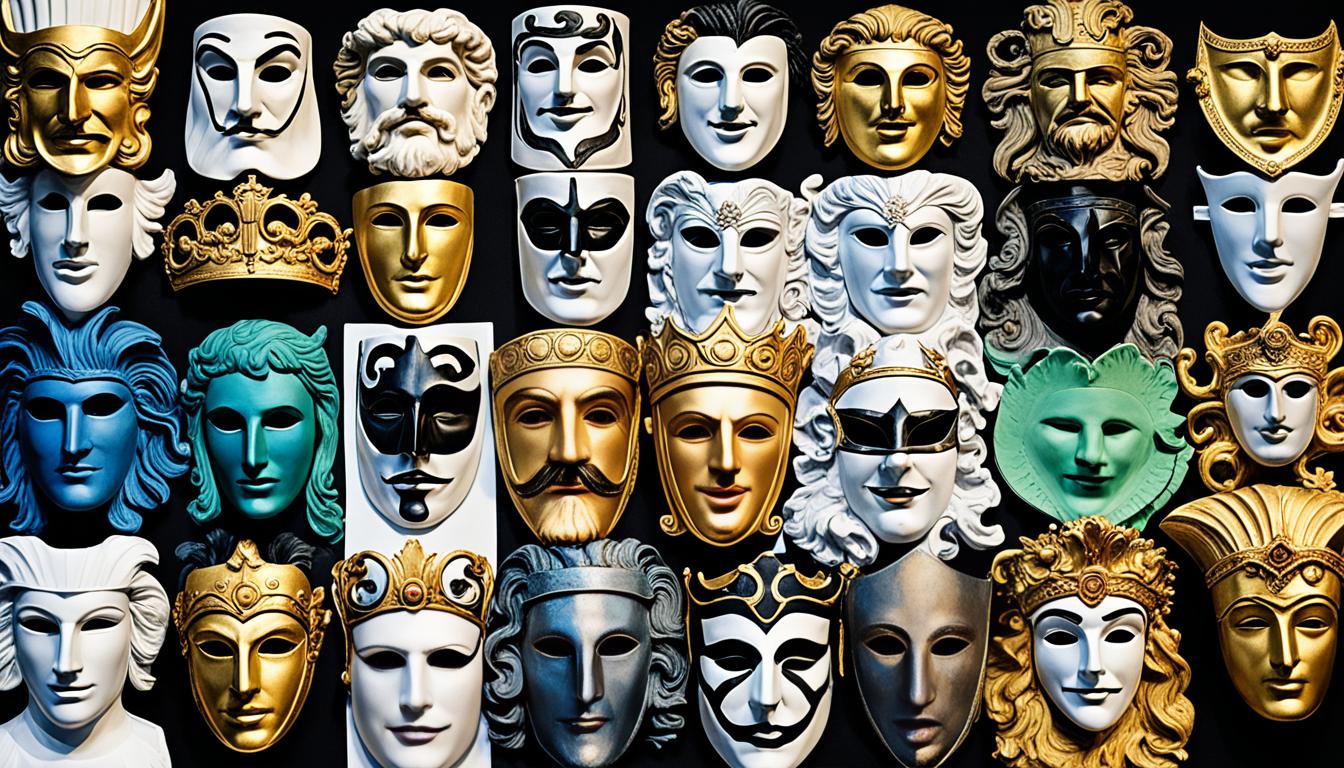
The world of theatre and drama has been a key part of human culture for thousands of years. This article will take you on a journey through the history of theatre. We’ll see how culture and history have shaped this art form.
From ancient Greece to modern times, we’ll explore the lasting impact of theatre on society. It shows how theatre reflects human desires, struggles, and achievements. It’s a story of human creativity and resilience.
Theatre has always been a mirror to the world, showing us the good and the bad. It has changed over time, adapting to new cultural and artistic trends. As we look at theatre’s history, we’ll see how each era has left its mark.
This journey is for everyone, whether you love theatre or are new to it. Get ready to travel through time, from ancient Greece to today’s modern plays. You’ll see how theatre has tackled big social and political issues, making it a powerful way to express ourselves and bring about change.
Theatre’s Ancient Roots and Traditions
The world of theatre has deep roots in ancient cultures. It started with ancient Greek theatre and grew with ancient Roman theatre. These traditions have lasted through the ages.
The Birth of Drama in Ancient Greece
In ancient Greece, drama began with religious festivals. Plays showed the Greeks’ beliefs and social life. Writers like Aeschylus, Sophocles, and Euripides made these stories come alive with their words.
Ancient Roman Theatre: Spectacle and Satire
Romans took theatre further, mixing stories with big shows and satire. Playwrights like Plautus and Terence made comedies that laughed at society. Roman shows had music, dance, and even gladiator fights for everyone to enjoy.
Today, ancient Greek and Roman theatre still shapes our culture. They remind us of the lasting power of stories and our shared human experiences.
The Renaissance: A Rebirth of Dramatic Expression
The Renaissance era was a time of great change in theatre. It brought back classical theatre and introduced new Elizabethan drama. This led to the lasting impact of Shakespearean drama, still loved by people all over the world today.
Shakespeare’s Enduring Legacy
William Shakespeare was a key figure in this theatre revival. His plays are still widely studied and performed today. Shakespeare mixed complex stories, deep characters, and beautiful language. This made him known as the greatest playwright ever.
His works range from the deep tragedy of “Hamlet” to the funny “A Midsummer Night’s Dream”. Shakespeare’s influence on theatre is huge, both during the Renaissance and now.
Shakespeare’s dramas are still popular today because of their deep themes and wide appeal. They make us think about life, power, morality, love, and betrayal. Shakespeare’s impact on theatre is huge, shaping it for over four hundred years.
The Culture of 17th and 18th Century Theatre
Exploring 17th and 18th century theatre reveals the cultural forces that shaped this era. The rise of Neoclassical drama was a key event. It focused on classical dramatic forms and themes.
The Rise of Neoclassical Drama
Neoclassical drama became popular during the Restoration theatre era. It mirrored the social and artistic values of the time. Playwrights aimed to bring back the elegance of ancient Greek and Roman theatre.
They focused on unity in action, time, and place. This led to a theatre that was refined and intellectually stimulating. It appealed to the upper classes in Europe.
The Restoration theatre was crucial in promoting Neoclassical drama. After the English Civil War and the monarchy’s return, theatre became more popular. Playwrights like William Congreve and John Dryden became famous.
They wrote complex plots and witty dialogue. Their works made Neoclassical drama a key part of European theatre history in the 17th and 18th centuries.

The Romantic Era: Emotion and Individualism
In the 19th century, theatre and drama changed a lot. The Romantic era, from late 18th to early 19th centuries, was all about deep feelings and celebrating each person’s unique view. Playwrights and actors broke free from old theatre rules. They focused on human emotions and personal stories.
The Romantic movement in theatre was a big change from before. Playwrights like Victor Hugo and Friedrich Schiller aimed to show the real power of human feelings. They explored passion, pain, and the human spirit deeply. Actors and actresses started to show their feelings more, moving away from stiff performances.
This move towards showing feelings and valuing each person was more than just art. It showed a shift away from the Enlightenment’s focus on reason and order. The Romantic era valued the personal, the creative, and the emotional. Playwrights and performers aimed to capture the true human experience, highlighting our complex feelings and our power to shape our lives.
The Romantic era’s impact is still seen in today’s theatre and arts. Artists keep exploring human emotions and celebrating individuality. From intense dramas to expressive acting, the Romantic movement’s spirit lives on in the theatre world.
Realism and Naturalism: Mirroring Life on Stage
In the 19th century, theatre changed a lot. Playwrights wanted to show real life on stage, not just fantasy. This change was inspired by realism in painting and literature.
The Influence of Henrik Ibsen
Henrik Ibsen, a Norwegian playwright, led this change. He’s known as the “Father of Modern Drama.” Ibsen’s plays questioned society and showed the deep sides of people.
His works, like “A Doll’s House” and “Ghosts,” talked about social issues and hidden truths. Ibsen’s style, focusing on reality, started the modern drama movement. Many playwrights around the world followed his lead, reflecting the 19th century’s struggles on stage.
Ibsen’s realism and naturalism changed 19th century theatre. His bold plays made audiences face hard truths about their lives. This shaped drama for many years to come.
The Birth of Modern Drama
When the 20th century started, a new era of theatre innovation was coming. Pioneering playwrights and avant-garde artists started to shake up traditional theatre. They brought in new styles and techniques, making modern drama possible.
Innovative Playwrights and Experimental Styles
Henrik Ibsen, August Strindberg, and Anton Chekhov changed modern theatre. They brought realism to the stage, focusing on human psychology and social issues. Their plays moved away from grand spectacles, showing the everyday life in a natural way.
At the same time, avant-garde dramatists started to explore new forms of theatre. Bertolt Brecht, Antonin Artaud, and Samuel Beckett introduced epic theatre, absurdist drama, and the “theatre of cruelty.” These styles made audiences question and face the harsh realities of the world.

The work of these visionaries had a big impact. It influenced many playwrights and directors to come. Their boldness in experimenting and addressing big issues helped keep theatre dynamic and thought-provoking.
Culture and Theatre in the 20th Century
The 20th century changed how theatre and culture interacted. The world faced fast social, political, and tech changes. Theatre became a key place to look at the modern human life.
Many cultural movements changed 20th century theatre. Expressionism, Surrealism, and Absurdism made theatre more complex. They pushed the limits of what theatre could be.
Playwrights like Bertolt Brecht, Samuel Beckett, and Harold Pinter made theatre talk about big issues. They tackled topics like totalitarianism and the search for meaning in life.
Theatre’s impact on society in the 20th century was huge. After two world wars, it offered a way to heal, think, and talk about big issues. Plays looked at identity, class, and what it means to be human.
From the start of the 20th century to the end, theatre kept evolving. It became a key place for political and social change. Theatre’s mix with culture in the 20th century still shapes our views on life and the arts today.
Contemporary Theatre: Pushing Boundaries
In the world of contemporary theatre, playwrights and companies are breaking new ground. They use the stage to talk about big social issues and celebrate diversity. This theatre is all about trying new ways of telling stories and getting the audience involved.
Exploring Social Issues and Diversity
Today’s theatre shows the many views and experiences of our world. Writers are dealing with tough topics like racial inequality and gender bias. They’re giving a voice to those who have been left out, making us think differently.
There’s also a big push for more diversity in theatre. More people from different backgrounds are getting to share their stories and talents. This change is making the theatre world richer and bringing new stories to the stage.
The theatre is always changing, and what’s possible on stage is getting broader. New ways of performing, like immersive shows, are becoming popular. These new styles are making theatre more exciting and engaging, pushing the art to new heights.
The Impact of Technology on Theatre
The theatre world is changing fast, thanks to technology. This change brings new ways to experience shows. Now, audiences can dive into virtual worlds and enjoy multimedia shows like never before.
Multimedia and Immersive Experiences
Thanks to advanced tech like projection mapping and virtual reality, shows can now wow us in new ways. These technologies let creators make shows that feel real and take us on amazing journeys. Now, the line between the stage and the audience is fading.
Now, lighting, sound, and visuals in theatre are more powerful than ever. This lets directors and designers be more creative. It makes shows look and feel better and opens up new ways to tell stories and connect with the audience.